
Importance
The Board of Directors of Airports of Thailand Public Company Limited (AOT) is firmly committed to corporate governance based on ethical principles. We adhere to the best practices for directors of listed companies, as well as comply with the laws, rules, regulations, and guidelines prescribed by the Stock Exchange of Thailand (SET) and the Securities and Exchange Commission (SEC). Moreover, we continuously strive to elevate AOT’s corporate governance toward international excellence.
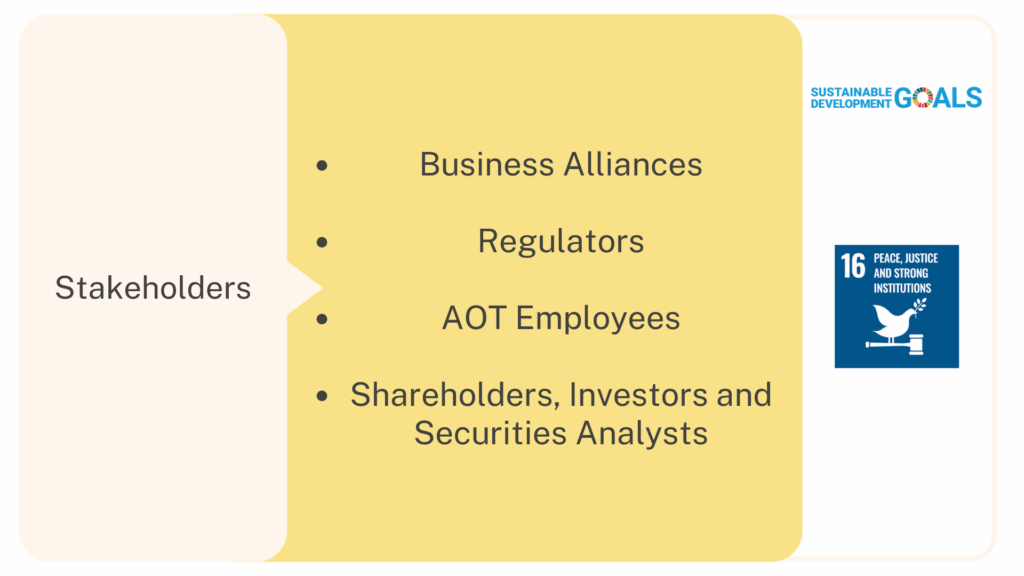
Good corporate governance serves as a vital foundation for building trust among all stakeholders. In this regard, shareholders and investors are assured of transparent, fair, and accountable management, which generates sustainable long-term value and returns. Simultaneously, customers and passengers receive high-quality, safe, and equitable services, supported by efficient feedback and grievance mechanisms.
In addition, AOT prioritizes fair and equal treatment for its employees and personnel, focusing on professional development and career advancement. Meanwhile, business partners and alliances are ensured fair competitive opportunities through transparent procurement processes. Furthermore, communities and society benefit from our commitment to environmental stewardship, safety, and engagement in sustainable development.
Ultimately, robust corporate governance yields multifaceted benefits for AOT. From an operational perspective, it enhances management efficiency and decision-making, mitigates business risks, and fosters an organizational culture of integrity. It further strengthens competitiveness and business growth, reduces financial and operating costs, and increases adaptability to change—thereby creating long-term value-add for the organization.
Policy
AOT conducts its corporate governance in accordance with the AOT Corporate Governance Policy and the 2024 Good Corporate Governance Handbook. These internal frameworks are aligned with the OECD Principles of Corporate Governance and the 2019 Good Corporate Governance Guidelines for State Enterprises.
Furthermore, our practices comply with the Corporate Governance Code (CG Code) for Listed Companies issued by the Securities and Exchange Commission (SEC), which is recognized by the Stock Exchange of Thailand (SET) and the Thai Institute of Directors (IOD).
In addition to internal standards, AOT references the 2020 Good Corporate Governance Guidelines for State Enterprises and the operational guidelines prescribed by the State Enterprise Policy Office (SEPO). We also integrate international sustainability assessment frameworks into our practices, including the S&P Global Corporate Sustainability Assessment (CSA), FTSE Russell, and the Ten Principles of the United Nations Global Compact (UNGC).
The aforementioned policy encompasses the Code of Ethics and Practice for the Board of Directors, overall corporate governance, and Corporate Social and Environmental Responsibility (CSER). It further dictates fair labor practices, respect for human rights, and the holistic care of all AOT stakeholders.
In this regard, AOT has established clear criteria and practical guidelines regarding Conflicts of Interest for the Board of Directors and senior executives. These measures provide a concrete framework to ensure that all duties are performed with impartiality and accountability. Furthermore, AOT is committed to full compliance with all relevant tax laws and regulations. We ensure that tax incentives are utilized strictly in accordance with the law and that our tax structures are managed transparently and ethically, maintaining a firm stance against tax avoidance.





Management Approach
AOT operates under a One-Tier Board System, with the primary objective of maximizing shareholder value and ensuring highly efficient corporate oversight. This framework encompasses the appointment of independent directors who possess a diverse range of expertise and competencies essential to the airport services industry.
To ensure continuous excellence, AOT has established robust systems for internal control, auditing, and oversight, alongside regular performance evaluations of the Board. These practices are strictly aligned with the Stock Exchange of Thailand (SET) Rules, ensuring full compliance with established best practices and regulatory requirements.
Board of Directors
AOT Board Structure – Board Leadership and Commitment to Sustainability
The Board of Directors serves as the cornerstone in defining the organization’s strategic direction. An appropriate board structure, combined with a diverse range of skills, enables effective leadership and multifaceted business decision-making—both of which are critical factors for sustainable development.To ensure thorough and efficient oversight of key operations, the AOT Board has established five specialized sub-committees: the Audit Committee, the Nomination Committee, the Remuneration Committee, the Corporate Governance Committee, and the Risk Management Committee.In alignment with our commitment to sustainability, AOT is dedicated to managing its impacts on the economy, environment, and society. This responsibility encompasses comprehensive respect for human rights and the guarantee of fair labor practices throughout our operations.

Regulations for the Board of Directors
The AOT Articles of Association stipulate the following requirements for the composition of the Board of Directors:
The Board shall consist of no fewer than five (5) and no more than fifteen (15) directors, all of whom shall be elected by the shareholders at the general meeting.
At least one-third (1/3) of the total number of directors must be independent directors, and in any case, the number must not be fewer than three (3).
No less than half of the total number of directors must have their residence in the Kingdom of Thailand.
At least one (1) director must possess knowledge and expertise in accounting and finance.
Qualifications of AOT Independent Directors
Pursuant to the Act on Standard Qualifications for Directors and Employees of State Enterprises B.E. 2518 (1975), restrictions are imposed to ensure the independence of executives. Under this Act, AOT’s senior executives, including the President and the executive management team, are prohibited from holding shares in the Company or having management-related interests, in order to avoid conflicts of interest. In this regard, AOT’s qualification requirements for independent directors are more stringent than the minimum requirements prescribed by the Securities and Exchange Commission (SEC) and the Stock Exchange of Thailand (SET). An Independent Director of AOT must meet the following qualifications:
- Holds no more than 0.5 percent of the total number of voting shares of AOT.
- Must demonstrate complete separation from managerial involvement and cannot serve as an employee, executive, compensated consultant, or controlling entity of AOT. This independence requirement must have been maintained continuously for a minimum two-year period preceding appointment.
- Must be entirely free from business relationships or conflicts of interest, whether direct or indirect, pertaining to financial or operational engagement with AOT.
- Must not maintain relative of, or other relationships that could potentially compromise independence with any director, senior executive, or substantial shareholder of AOT.
- An individual who meets the above criteria (1–4) may be assigned by the Board of Directors to participate in decision-making in a collective capacity only, without exercising individual executive authority.
- Must not serve as external auditor or professional service provider, including legal counsel or financial advisory services to AOT, with such relationships having been discontinued for no less than two (2) years.
- Must not engage in substantially similar business operations competitive with AOT, nor serve as material partner, executive director, employee, or compensated advisor to competing entities, nor maintain equity holdings exceeding 1% of voting shares in such organizations.
- Must not possess any other characteristics that would impair the ability to provide independent and objective judgment on AOT’s operations.
Nomination and Selection Process for the Board of Directors and the President
The Board of Directors Nomination and Selection Process
| When an AOT Director position becomes vacant. | Step 1: Shareholders and/or the Nomination Committee propose candidates to the AOT Board of Directors for consideration. | Step 2: The Nomination Committee selects and submits the shortlist to the AOT Board of Directors for approval. | Step 3: The AOT Board of Directors selects the director or proposes the candidates to the Shareholders' Meeting for election as AOT directors. |
Members of the AOT Board of Directors are appointed in accordance with the criteria and timeframes prescribed by laws and regulations governing state enterprises, specifically the Public Limited Companies Act, B.E. 2535 (1992) and the Standard Qualifications for State Enterprise Board Members and Employees Act, B.E. 2518 (1975). These frameworks ensure that corporate governance remains continuous, transparent, and accountable.
In the event of a vacancy or when a director’s term is nearing completion, the Nomination Committee identifies suitable candidates from the Ministry of Finance’s State Enterprise Directors’ Pool. Nominees must possess qualifications that comply with Thai laws and regulations, as well as AOT’s Corporate Governance Policy. Furthermore, candidates must demonstrate competencies, knowledge, and expertise aligned with the company’s business operations and organizational strategy before being presented for appointment via a formal vote by the AOT Board of Directors.
Board Diversity
AOT recognizes the importance of gender equality and is committed to enhancing gender diversity on its Board of Directors, in alignment with global sustainability practices and SDG 5 (Gender Equality). This commitment is formally stated in AOT’s revised Corporate Governance Policy, which identifies board diversity including gender, age, ethnicity, nationality, religion, and place of origin as a key consideration in the director nomination process. To promote diversity and inclusivity, AOT has established a target to maintain a minimum of 40% female representation on its Board of Directors.
| Board Member Selection Criteria | |
|---|---|
|
Regulatory Compliance & Governance
Adherence to Thai Laws, Regulations, and AOT Corporate Governance Policy:
|
Competencies & Expertise
Expertise relevant to AOT's business and State Enterprise requirements: 1. Global Industry Classification Standard 2023 (GICS):
2. AOT Board Skill Matrix Analysis |
The President Nomination and Selection Process
| When the position of AOT President becomes vacant, an open recruitment process shall be initiated. | Step 1: The Nomination Committee proposes candidates in accordance with the Succession Plan. | Step 2: The AOT Board of Directors submits the selected candidate to the Remuneration Subcommittee to review compensation and the draft employment contract. | Step 3: The Ministry of Finance approves the remuneration and draft contract, then submits them to the AOT Board of Directors for formal appointment. |
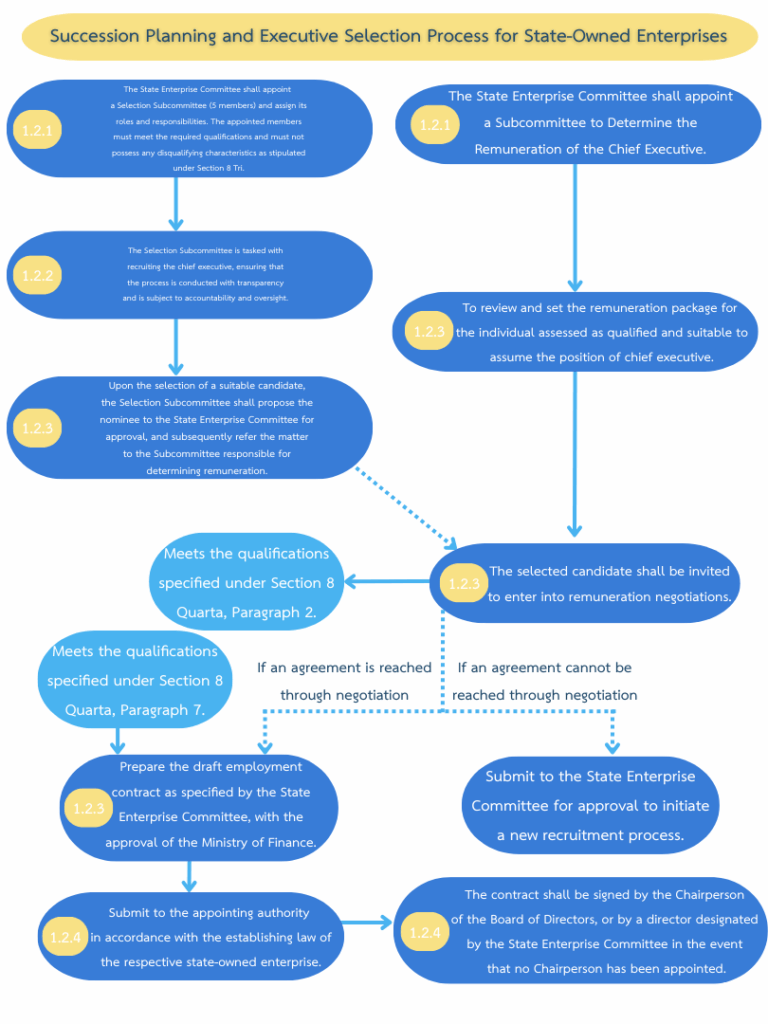
The recruitment of the President of AOT shall be carried out in accordance with Section 8 Jattawa of the Standard Qualifications for Directors and Employees of State Enterprise Act, B.E.2518 (1975), as amended by the Sixth Amendment of B.E. 2550 (2007). The process is as follows:
- The AOT Board of Directors establishs a Nomination Committee comprising 5 members who possess the required qualifications and be free from any disqualifying characteristics as stipulated in Section 8 Tri (1), (3), (4), (5), (6), (11), and (12).
- The Nomination Committee is responsible for selecting qualified candidates who possess the requisite knowledge, competencies, and experience suitable for the position of President. Such candidates must fulfill the qualifications and be exempt from any disqualifying characteristics as prescribed in Section 8 Tri (1), (3), (4), (5), (6), (9), (10), (11), and (12). Candidates must not serve as directors of AOT, except for executives who hold directorship by virtue of their position. Additionally, candidates must not exceed 58 years of age on the date of application submission.
- Once suitable candidates have been identified, the names shall be submitted to the authorized person for consideration and appointment. More than one candidate may be proposed.
- The recruitment and appointment process must be completed within one year from the date the former President vacates the position.
- The employment term of the President shall not exceed 4 years per contract, effective from the commencement date of the employment agreement.
Board & CEO Effectiveness
AOT places high importance on promoting diversity and gender equality at both the Board and executive levels. We firmly believe that a diversity of perspectives, experiences, and expertise enhances the quality of corporate governance, strategic decision-making, and long-term organizational sustainability.
AOT adheres to the principle of non-discrimination and promotes equal opportunities for individuals to assume positions within the Board of Directors and executive management. Appointments are primarily based on qualifications, knowledge, professional competence, experience, and ethical integrity, without limitations regarding gender, age, or personal background. This approach reflects management practices that align with corporate governance principles, sustainability standards, and international best practices for good governance.
Although the appointment of AOT’s Board of Directors follows the legal frameworks and nomination processes established for state enterprises, AOT remains steadfast in its commitment to continuously promoting diversity and gender balance at both the Board and executive levels.
In this regard, AOT has established policy guidelines to support gender diversity within its corporate governance framework, focusing on the following process-based targets:
Promote Balanced Representation: Encourage the consideration of qualified candidates of all genders in the recruitment and nomination processes for Board members and executives, aiming for a balanced proportion across all related procedures.
Empower Female Leadership: Support the potential development of female leaders within the organization to enhance their opportunities for advancement into senior executive roles and to cultivate a talent pool for future Board-level consideration.
Monitor and Review Diversity Data: Regularly monitor and review the gender proportions of the Board and executive management to provide essential data for shaping organizational development strategies regarding diversity and inclusion.
Furthermore, AOT aims for its corporate governance structure to appropriately reflect diversity, while remaining steadfast in the principles of meritocracy, competence, and professionalism. This approach is intended to support comprehensive strategic decision-making and to reinforce long-term stakeholder confidence.
Performance Criteria and Evaluation of the Board of Directors and the President
AOT has established a Minimum Attendance target for Board of Directors meetings at 80% of the total meetings held annually. (AOT conducts at least 12 Board meetings per year, with a requirement of at least one meeting every three months. Furthermore, a director’s term shall be terminated if they are absent for more than three consecutive meetings without a reasonable justification).
Regarding the Number of Mandates, directors are restricted from holding board positions in more than three state enterprises and/or legal entities, and no more than five listed companies on the Stock Exchange of Thailand (SET). Additionally, the AOT Board undergoes an annual Self-assessment of Board Performance as well as an annual Independent Assessment of Board Performance (Group Evaluation) conducted by an external agency.
Self-Assessment of the Board of Directors
AOT determines the AOT requires its Board of Directors to conduct an annual self-assessment as a framework for performance appraisal of the Board and to jointly consider the results and problems in order to improve the performance of the Board of Directors. The assessment consists of:
- Self-Assessment of Individual Directors
- Assessment of the Board of Directors
- Self-Assessment of Subcommittee
In addition, AOT’s Board of Directors has been externally assessed by using the Guidelines and State Enterprise Assessment Model of the State Enterprise Policy Office, the Ministry of Finance (SEPO) in terms of good governance and organizational leadership including assessment through the Corporate Governance Report Project of Thai Listed Companies of the Thai Institute of Directors (IOD) Association, which is consistent with the international assessment criteria of the ASEAN CG Scorecard.
Assessment of President’s Performance
The president’s performance is evaluated against comprehensive indicators encompassing both financial metrics and sustainability measures across multiple dimensions relevant to airport management operations, in alignment with AOT Master Plan. Key performance areas include customer satisfaction, climate change resilience, and innovation initiatives. These indicators are systematically cascaded to senior executives across relevant operational divisions. Performance outcomes serve as direct determinants for both short-term and long-term remuneration decisions for the president and senior management team.
AOT Remuneration Policy
AOT discloses the remuneration structure for its senior executives, including the President, Senior Executive Vice Presidents, and other high-level executives as defined by corporate regulations and guidelines. This disclosure ensures transparency and strictly adheres to the principles of Good Corporate Governance.
The executive remuneration structure consists of Fixed Remuneration and Variable Remuneration, both of which are calculated based on Key Performance Indicator (KPI) scores encompassing both financial and non-financial dimensions, such as organizational development and sustainability. The details are as follows:
Fixed Remuneration: This includes basic salary and other benefits determined by position and scope of responsibility. These rates are within the framework approved by the relevant committees and comply with the laws and regulations applicable to state enterprises.
Variable Remuneration: This refers to performance-based incentives or rewards linked to the organization’s overall success and the executive’s individual performance. These are evaluated based on the achievement of defined goals and indicators, taking into account financial performance, operational excellence, and corporate governance.
The determination and review of senior executive remuneration are conducted under the oversight of the relevant committees. This ensures that compensation remains appropriate, aligns with roles and responsibilities, and supports long-term value creation for the company and its stakeholders.
However, the determination of remuneration for AOT’s senior executives is strictly governed by relevant legal frameworks and regulations. Notably, Section 8 of the Standard Qualifications for State Enterprise Board Members and Employees Act, B.E. 2518 (1975) imposes significant restrictions, including the prohibition of senior executives from holding shares or having managerial interests in AOT’s business. Furthermore, executive employment terms are limited to a maximum of four years per term. This mechanism is designed to prevent the monopolization of power and to incentivize executives to deliver performance within a specified timeframe.
While AOT is unable to provide long-term incentives in the form of equity-based interests or stock options, as is common in private corporations, it has established alternative long-term incentive mechanisms that comply with the legal framework. Specifically, the “Renewal of Employment Contract” serves as a vital incentive, compelling executives to produce consistent and tangible results. Remuneration and contract renewal considerations are directly linked to performance, efficiency, and contributions toward the organization’s long-term interests.
The renewal of an executive’s contract upon the completion of their term is subject to the review of relevant committees and requires approval from the appropriate regulatory authorities. These appointments are made in accordance with statutory requirements and are subject to clear term limits. Consequently, these mechanisms function as a form of long-term incentive that prioritizes sustained performance, management continuity, and organizational accountability over short-term financial gain.
AOT focuses on establishing a remuneration management system that reflects good corporate governance and long-term sustainable value creation. Detailed information is disclosed in accordance with standard criteria as follows:
| High-level Principles | Process for Setting Remuneration |
|---|---|
|
AOT links remuneration to the achievement of four key corporate objectives to drive sustainable benefits, as follows:
|
AOT maintains a transparent and accountable remuneration process through the following board mechanisms:
|
AOT recognizes the importance of protecting shareholders’ rights and encourages shareholders to fully exercise their fundamental rights as business owners. This is achieved through a corporate governance structure featuring a Board of Directors elected by the shareholders, alongside providing equal and transparent opportunities for shareholders to attend and cast their votes at Shareholders’ Meetings.
The determination of remuneration for directors and executives is designated as a specific agenda item in the Annual General Meeting of Shareholders (AGM). Policies, criteria, and remuneration structures are clearly disclosed in the invitation notice and supporting documents to ensure shareholders can make informed voting decisions. Furthermore, AOT’s Corporate Governance Policy explicitly mandates the respect and promotion of shareholders’ fundamental rights, including the annual right to vote on agendas related to director and executive compensation. AOT refrains from any actions that would restrict or infringe upon these rights, ensuring that the setting of remuneration remains transparent, fair, and aligned with the principles of Good Corporate Governance.
AOT Board and Executive Development
AOT places strong emphasis on the continuous development of knowledge and the acquisition of new experiences. The Company consistently supports its directors in attending training programs and seminars organized by the Thai Institute of Directors Association (IOD), which are specifically designed for board members and senior executives. Examples of such programs include:
Director Accreditation Program (DAP)
Director Certification Program (DCP)
Advanced Audit Committee Program (AACP)
Ethical Leadership Program (ELP)
Financial Statements for Directors (FSD)
Monitoring the System of Internal Control and Risk Management (MIR)
Monitoring the Internal Audit Function (MIA)
Risk Management Program for Corporate Leaders (RCL)
Corporate Governance for Executives (CGE)
Successful Formulation & Execution of Strategy (SFE)
Clawback Provision
As a company listed on the Stock Exchange of Thailand, AOT is required to operate in accordance with the Securities and Exchange Act B.E. 2535 (1992), Section 89/7, which stipulates that directors and executives must perform their duties with responsibility, due care, and integrity. They are also obligated to act in compliance with applicable laws, corporate objectives, articles of association, board resolutions, and shareholders’ meeting resolutions.
In cases where a director or executive acts or omits to act in breach of such duties, resulting in unlawful benefits being obtained by the director, executive, or related parties, the company may initiate legal proceedings to reclaim such benefits, pursuant to Sections 89/18 and 89/19 of the Act.
The Right To Vote
AOT has established the following regulations regarding shareholding and voting rights:
Independent Directors: AOT Independent Directors may hold no more than 0.5% of the total voting shares in AOT, its subsidiaries, affiliates, joint ventures, major shareholders, or controlling persons. This threshold includes shares held by related persons of each Independent Director.
President: In the capacity of a Board Member, the President is prohibited from holding any shares in accordance with the Standard Qualifications for State Enterprise Board Members and Employees Act, B.E. 2518 (1975).
Remarks:
- For further details regarding AOT’s Top 10 Major Shareholders, please refer to the “Nomination and Appointment of Directors and the President” section in the Annual Report.
- AOT shares held through Thai NVDR Co., Ltd. do not carry voting rights at Shareholders’ Meetings, as they are Non-Voting Depository Receipts (NVDR). An exception is made for voting on resolutions regarding the delisting of shares from the Stock Exchange of Thailand (SET).
- AOT does not have any Golden Shares held by government entities.
The Role of the President in Driving AOT’s Sustainable Development
The President is committed to developing AOT into a sustainably growing organization while managing the impacts of its business operations across economic, environmental, and social dimensions. High priority is placed on Anti-Corruption in all forms, respect for Human Rights, Environmental stewardship, and the promotion of Decent Work and well-being for all employees.
In the realm of sustainable development, the President plays a pivotal role in establishing Organizational Sustainability Targets, reviewing Business Model Risks, and overseeing Sustainability Reporting. This includes driving the annual assurance of sustainability performance data and formulating corporate policies that align with key sustainability issues. Furthermore, the President ensures the effective implementation of these sustainability policies and guidelines across the organization. Emphasis is also placed on addressing employee concerns and integrating lessons learned from the workforce to foster continuous and sustainable organizational development.
President’s Sustainability Key Performance Indicators (KPIs)
- S&P Global CSA Score (Dow Jones Sustainability Indices – Best-in-Class World)
- Renewable Energy System Installation Solar Power Project
- Return on Equity (ROE)
- Non-Aeronautical Revenue
- Capital Expenditure (CAPEX) Management & Investment Plan Execution
Board Committee
| Audit Committee |
|
| Nomination Committee |
|
| Remuneration Committee |
|
| Corporate Governance Committee |
|
| Risk Management Committee |
|
| Sustainability Committees | |
| Corporate Social Responsibility Committee for Sustainable Development |
|
AOT President
Key Performance Indicators of the AOT President (CEO Compensation – Success Metrics) are aligned with the AOT State Enterprise Plan for Fiscal Years 2023 – 2027, Revised Edition (Fiscal Year 2024). These metrics encompass the following areas:
| Dimension | Performance Indicators (KPIs) |
|---|---|
| Short-Term Metrics | |
| Financial |
|
| Environmental |
Climate Change
|
| Governance |
Innovation
|
| Social |
Human Capital Development
|
Senior Executives: Positions, Shareholding, and Sustainability Performance Indicators
| Senior Executives | Position | AOT Shareholding (Shares) | Sustainability Indicators (KPIs) |
|---|---|---|---|
| Head Office | |||
| Mr. Kerati Kijmanawat | President | 0 | As specified above |
| Mr. Kittipot Venununta | Senior Executive Vice President (Digital Technology and Innovation) | 10,000 (0.0000%) |
|
| Mr. Anek Thiraviwatchai | Senior Executive Vice President (Strategy) | 0 |
|
| Mrs. Chadanisa Chumnanvech | Senior Executive Vice President (Human Resources and Administration) | 0 |
|
| Mr. Janvit Musigarat | Senior Executive Vice President (Accounting and Finance) | 1,000 (0.0000%) |
|
| Mr. Sirote Duangratana | Senior Executive Vice President (Business Development and Marketing) | 0 |
|
| Ms. Paweena Jariyathitipong | Senior Executive Vice President (Engineering and Construction) | 3,100 (0.0000%) | - |
| Ms. Suksri Luang-aram | Senior Executive Vice President (Airport and Aviation Standard) | 0 | - |
| Mr. Sompob Paksawan | Senior Executive Vice President (Regional Airports) | 0 | - |
| Mr. Krich Pakagij | Corporate Secretary | 0 | - |
| Airports | |||
| Mr. Kittipong Kittikachorn | General Manager of Suvarnabhumi Airport | 0 |
|
| Mr. Wichit Kaewsaitiam | General Manager of Don Mueang International Airport | 10,000 (0.0000%) |
|
| Mr. Monchai Tanode | General Manager of Phuket International Airport | 100 (0.0000%) |
|
| Group Captain Ronnakorn Chalermsaenyakorn | General Manager of Chiang Mai International Airport | 430 (0.0000%) |
|
| Mr. Kritsada Pukasap | General Manager of Hat Yai International Airport | 0 |
|
| Squadron Leader Somchanok Tiamtiabrat | General Manager of Mae Fah Luang Chiang Rai International Airport | 0 |
|