
Background and Rationale
Impacts from Business Operations
AOT places strong emphasis on enhancing customer experience and satisfaction, recognizing that airport service quality directly influences public confidence, corporate image, and the country’s competitiveness within the global aviation industry. Effective management across areas such as passenger facilitation, flight operations, safety, and service area quality are all critical factors shaping the experiences of passengers, airlines, operators, and all stakeholder groups.
In 2025, the aviation industry continued to recover and grow alongside the increase in international travel. At the same time, passengers increasingly expected greater convenience, speed, safety, and digital-enabled services. In response, AOT remains committed to improving service quality in alignment with the standards of the International Civil Aviation Organization (ICAO) and Airports Council International (ACI), with the aim of delivering a seamless travel experience and addressing the evolving needs of passengers in all dimensions.
Challenges and Opportunities
The increasing number of passengers and the growing complexity of airport services present significant challenges that may affect space congestion, waiting times, and overall service efficiency. At the same time, rapidly changing consumer behavior in the digital era has led passengers to expect seamless, convenient, and fast services throughout every stage of their journey.
Nevertheless, these changes also present important opportunities for AOT to advance toward becoming a Smart Airport through the adoption of technology and innovation. Examples include automated service systems, contactless services, and the use of passenger behavioral analytics to enhance service delivery in a more targeted manner. In addition, effective complaint management and active engagement with customer feedback help strengthen passenger satisfaction, confidence, and long-term loyalty toward the organization.
Commitment
Vision, and Mission of Customer Relationship Management Operations
Vision:
To be a leading organization with a modern and efficient customer relationship management system.
Mission:
To manage customer relationships with airlines, passengers, commercial operators/tenants, and airport service users in order to enhance customer satisfaction and build business partnerships.
Management Approach
AOT is dedicated to the systematic advancement of Customer Relationship Management (CRM), aiming to enhance service excellence at every touchpoint and deliver a truly memorable journey for our passengers and stakeholders.
| Service Improvement Goals | Planning and Responsibility Assignment |
|---|---|
|
The development approach has been designated as one of the key performance indicators in AOT’s Corporate Plan for Fiscal Years 2023–2027 (Revised for FY2024), and has been defined as part of AOT’s Customer Relationship Management (CRM) strategy.
|
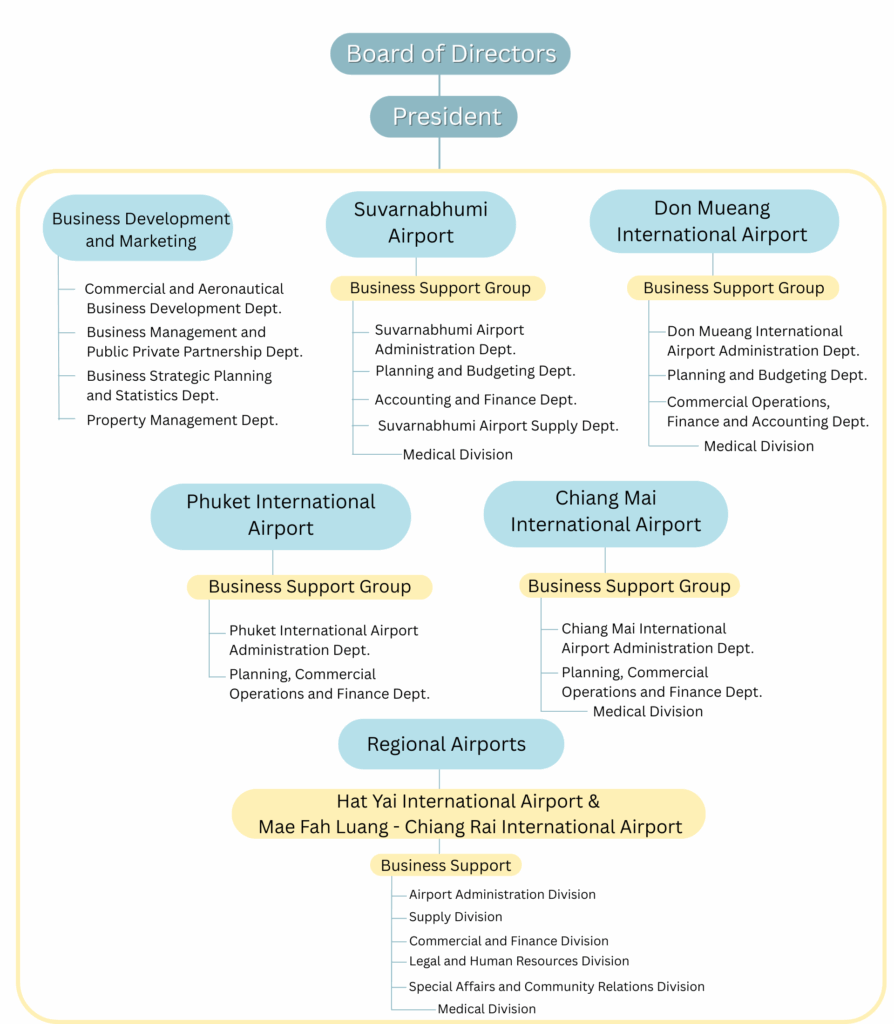
Governance Structure and Policy Implementation for Customer Relationship Management at AOT
| KPI | Performance 2025 |
Target | ||||
|---|---|---|---|---|---|---|
| 2024 | 2025 | 2026 | 2027 | |||
| Develop initiatives to enhance satisfaction across all service touchpoints to improve process efficiency and overall passenger satisfaction (Inspire Memorable Airport Experience) | ||||||
| 1. Suvarnabhumi Airport ranking by Skytrax | 39 | 58 | 50 | 46 | 34 | |
| 2. Number of airports ranked as Performers by ACI | 3 | 2 | 3 | 4 | 4 | |
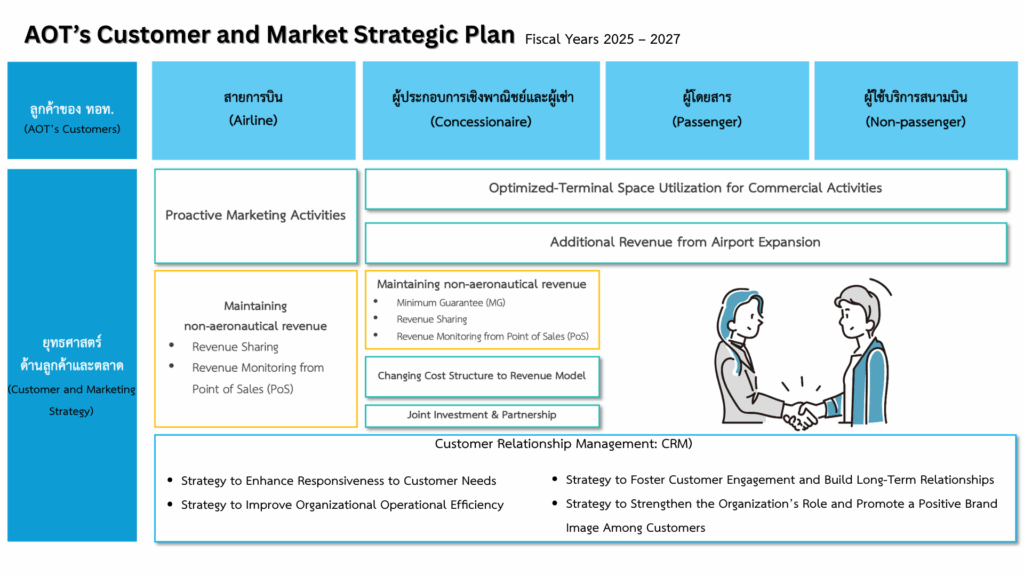
AOT's Customer Relationship Management Strategy
AOT recognizes the increasing competitiveness in the aviation industry both domestically and globally. In response, AOT places a strong emphasis on Customer Relationship Management (CRM) to enhance its ability to meet customer needs, improve satisfaction, and foster long-term relationships. The strategy focuses on the importance of both customers and service users in strengthening the company’s revenue and long-term corporate image.
AOT’s CRM approach is based on two key principles:
- Delivering appropriate and tailored value to customers and service users
The value offered must be aligned with each customer’s expected long-term contribution in terms of revenue and return on investment, ensuring that the benefits provided are commensurate with the costs incurred. - Creating service value that truly meets customer needs
This involves analyzing customer behavior and preferences to design personalized offerings and services that are relevant and resonate with them at every point of interaction or service touchpoint.
This approach contributes to customer retention and expansion, leading to long-term profitability for the organization.
Moreover, the implementation of Customer Relationship Management (CRM) within the organization helps reduce service costs and expenditures by enhancing the efficiency of customer interactions and the delivery of value through products and services.
AOT has defined four key CRM strategies as follows:
| Strategy | Plan |
|---|---|
| 1. Strategy to Enhance Responsiveness to Customer Needs |
|
| 2. Strategy to Improve Organizational Operational Efficiency |
|
| 3. Strategy to Create Sustainable Customer Engagement and Motivation |
|
| 4. Strategy to Promote a Positive Organizational Image to Customers |
|
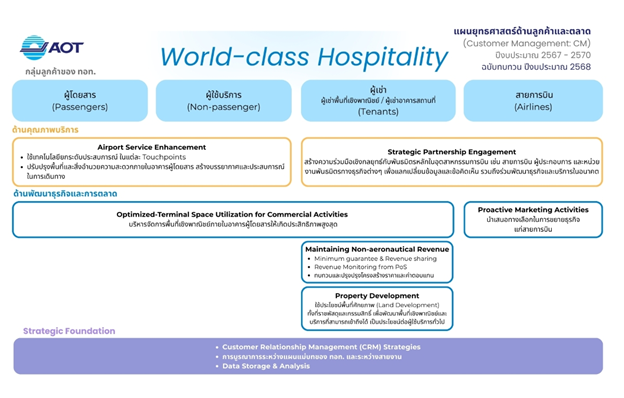
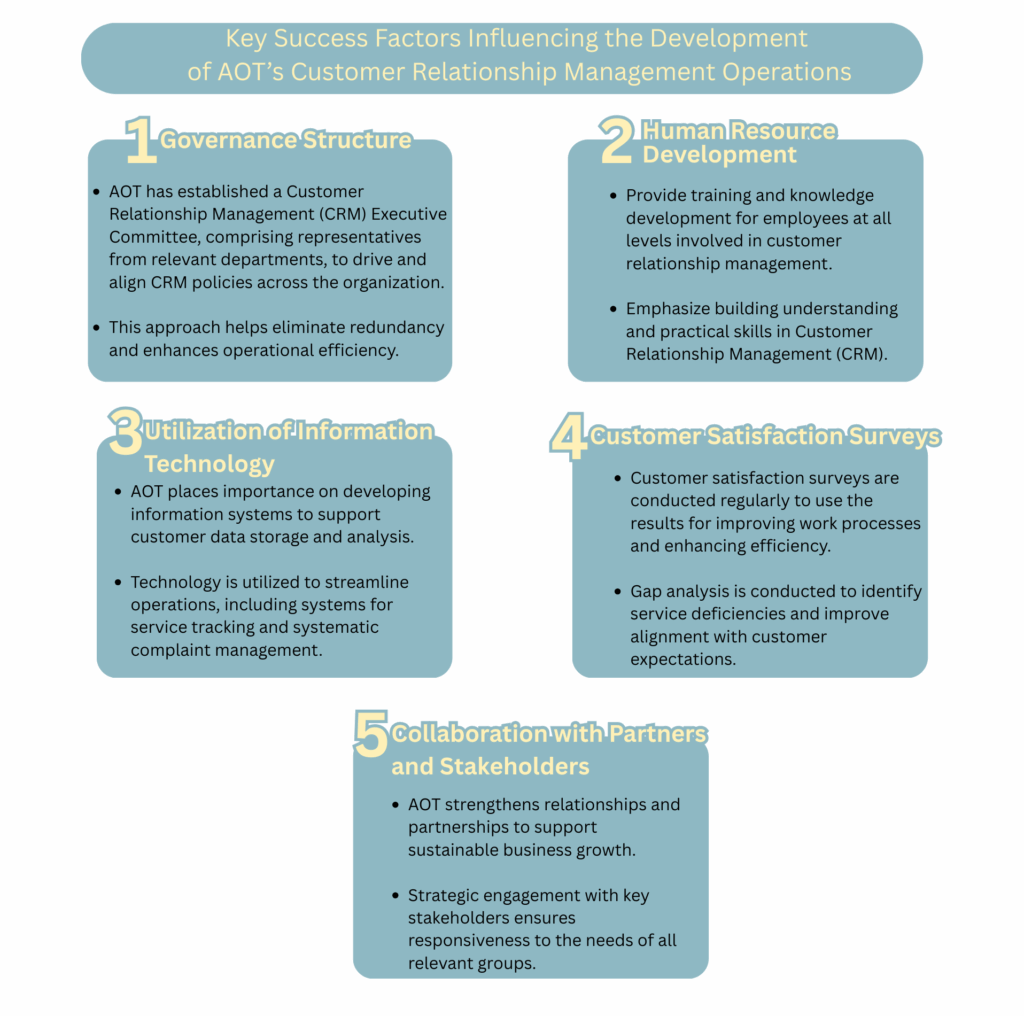
Key Success Factors Influencing the Development of AOT’s Customer Relationship Management Operations
Customer Feedback & Suggestions Channels
AOT provides multiple channels for receiving complaints and suggestions, ensuring convenience for customers and stakeholders to voice their feedback. All complaints are screened and forwarded to the relevant departments for resolution through a systematic and transparent complaint management process.
The performance results and status of complaint handling are reported to Senior Management on a monthly and quarterly basis. This data is analyzed to establish guidelines for continuous service quality improvement. Furthermore, key insights and “lessons learned” are communicated to internal departments to elevate overall service standards, enhance competitive advantage, and ensure the ongoing effectiveness of the complaint management framework.
- Complaint form available at the information counter inside the airport
- 📞 AOT Contact Center 1722
- Facebook: AOT Official
- Email: aotpr@airportthai.co.th
- www.airportthai.co.th > Contact Us > Contact and Submit Complaints
- AOT Contact Center 1722
- Internal contact number
- Line
- Suggestion box
- Direct submission via complaint notification letter
- Complaint Form available at airport information counters
- 📞 AOT Contact Center 1722
- Facebook: AOT Official
- Email:
- csd@airportthai.co.th (Customer Service Department)
- aotpr@airportthai.co.th
- Monthly Facilitation Committee (FAL) Meetings
- Monthly Airport Operations Committee (AOC) Meetings
- Quarterly Security Management System (SMS) Committee Meetings
- Monthly Baggage Committee Meetings
- Monthly Working Group Meetings
- Appointments / Courtesy Visits / Seminars
Implementation
AOT enhances customer satisfaction by analyzing key Airport Service Touch Points, integrating data from four primary airport service assessment tools. These include quantitative data such as Level of Service (LOS), and qualitative data such as Airport Service Quality (ASQ). Additionally, insights are gathered through direct Customer Feedback and Focus Group discussions with commercial operators and airline representatives. This integrated approach enables AOT to continuously improve its services and align them with passenger expectations.
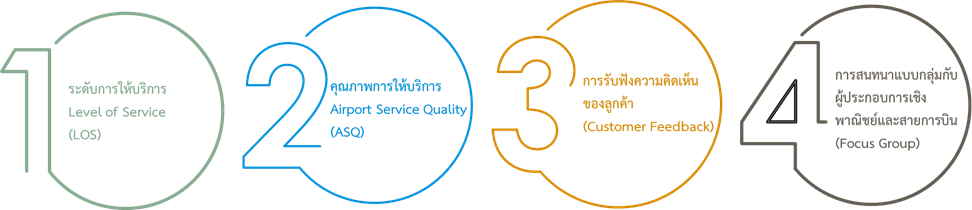
Customer Satisfaction Survey
1. Level of Service: LoS
The Level of Service (LoS) is a tool used to evaluate service performance along the passenger journey—both inbound and outbound—by measuring wait times and passenger density across key airport touchpoints. These include passenger lounges, check-in counters, security screening areas, baggage screening points for departing passengers, and boarding gates. LoS assessments are classified into four categories: Under-Provided, Sub-Optimum, Optimum, and Over-Design.
2. Airport Service Quality: ASQ
AOT participates in the Airport Service Quality (ASQ) program conducted by Airports Council International (ACI), a globally recognized benchmark in airport service performance. This evaluation measures passenger satisfaction through a standardized questionnaire used worldwide. Sample indicators assessed under the ASQ program include check-in experience, availability of public transportation, satisfaction with shops and restaurants (products/services), security screening processes, and the service provided by airport staff.
3. Customer Feedback
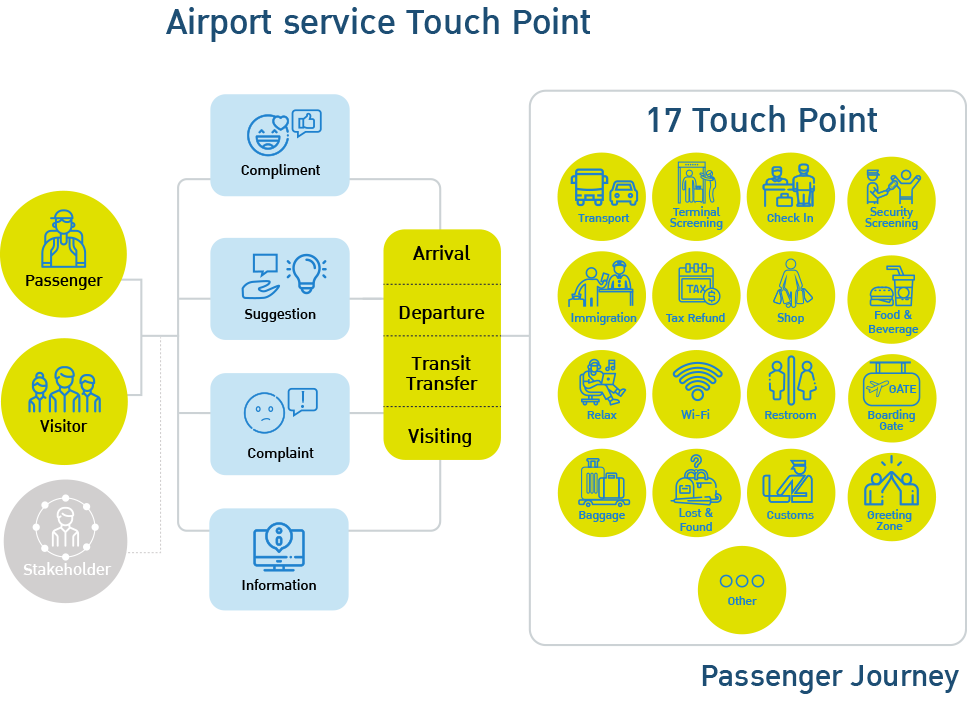
AOT collects and analyzes statistics on complaints, suggestions, and compliments to improve its services and overall business operations. The analysis incorporates theories, academic research, best practices, and insights from leading international airports. At present, AOT monitors passenger feedback across 17 key service touchpoints along the passenger journey. The aggregated data is used to enhance service quality on a monthly basis.
4. Focus Group Discussions with Commercial Operators and Airlines
AOT conducts satisfaction surveys with airline representatives, commercial operators, and other relevant stakeholders through both face-to-face and online workshops. These in-depth interviews aim to identify critical factors influencing customer loyalty, with reference to the Net Promoter Score (NPS) framework.
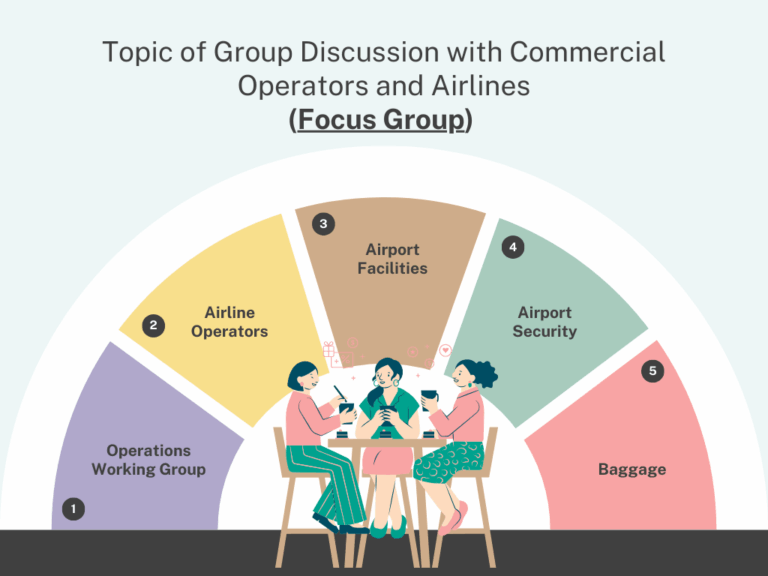
AOT has appointed the Customer Service Department, comprising the Customer Services Division, the VIP and Customer Relations Division, and the Complaint Management Divisions at each airport, to be responsible for monitoring the results of customer satisfaction surveys, conducting focus group discussions with commercial operators and airlines, and reviewing reports submitted through various complaint channels. Each fiscal year, all relevant departments convene monthly meetings covering the following 5 key topics:
Online Services
Online services represent a strategic initiative to bolster service delivery and drive Non-Aero Revenue, which accounts for more than 54% of AOT’s total income. This includes diverse offerings such as Duty-Free shopping, airport retail and dining, and ground services like automated Check-in points, all designed to enhance passenger convenience and speed.
To elevate the passenger journey, AOT has developed a suite of online services and digital solutions that enable efficient online payments and seamless airport navigation through secure and user-friendly platforms. These digital initiatives have contributed 0.039% to AOT’s revenue growth. By streamlining travel procedures and increasing accessibility, these digital services align the passenger experience with international Smart Airport expectations.
AOT’s core online platforms and digital solutions include the following:
- SAWASDEE by AOT Application
Service Reservations: Passengers can book various airport services such as lounges, parking, and transportation directly through the application. - Digital Advertising
Online Advertising: AOT leverages digital platforms to offer advertising space to business owners, thereby generating revenue from advertising fees. - AOT Digital Airports
Integrated Services: This initiative involves the development of innovative systems that connect all of the airport’s IT systems to enhance convenience for airport users. It integrates digital platforms across all airport systems, including related agencies, to improve operational efficiency and passenger experience. This integration also supports multiple revenue channels, such as premium services and business partnerships. - Integration of Electronic Payment Systems (E-Payment)
SAWASDEE by AOT Application: The application supports multiple payment methods including credit/debit cards, e-wallets, and other digital payment solutions, enabling users to complete transactions conveniently and securely. With integration into Google Cloud’s data infrastructure, the SAWASDEE by AOT application can handle up to 10 times more usage than conventional applications and serves as a comprehensive travel application. - Cloud-Based Solutions: AOT has migrated its IT infrastructure to Google Cloud, a secure and scalable platform. This enables efficient management of online payments and data storage, in collaboration with SKY ICT, a provider of aviation technology solutions that supports AOT’s ground service IT systems.
Furthermore, AOT has implemented a robust Information Security and Privacy Management System along with stringent security measures to protect user data and ensure secure transactions. This includes data encryption and compliance with data protection regulations.
Performance
SAWASDEE by AOT
AOT has developed the “Sawasdee” application, a Super App that integrates all essential travel services into a single platform. The app is now fully operational across all 6 airports under AOT’s management, enhancing connectivity and service continuity for passengers.
| Flights | Flight Notifications | Taxi Reservation | Queue Time | |
| Real-time flight board data from airports for both arrivals and departures, including flight status, boarding gate, and other related information. | Receive important flight notifications such as schedule changes, gate changes, and other critical announcements. | Taxi booking service and dedicated waiting lanes for special passengers using the mobile application. | Displays queue time information at check-in counters, security checkpoints, and immigration counters to help passengers plan their journey efficiently. |  |
| SAWASDEE Pay | Privileges | Supported Languages 8 Languages |
Tourist Help | |
| Digital wallet developed in collaboration with Krungthai Bank, linked to debit and credit cards (Visa and MasterCard) for purchases at partner stores both inside and outside the airport. | Access to various privileges such as up to 50% discounts at airport shops, restaurants, and service providers. |
|
Collaboration with the Tourist Police to facilitate and ensure safety for travelers. |
Customer Satisfaction Survey
AOT has compiled data from the FY2025 Customer Satisfaction, Dissatisfaction, and Corporate Image Survey. The study covered three key customer groups across all six AOT airports, representing the full scope of AOT’s business operations.
The survey utilized the Likert Rating Scale to measure and evaluate satisfaction levels and perceptions of the corporate image
| Airlines | Airlines Air transport operators that use airport infrastructure, facilities, and services to provide passenger and/or cargo transportation, including related flight operations. | |
| Commercial Operators / Tenants | Individuals or legal entities that are granted rights to operate or lease space within the airport for commercial activities or service provision, such as retail shops, restaurants, service providers, and other businesses operating within the airport premises. | |
| Customers / Visitors | Airport Service Users Individuals or organizations that use airport services, areas, or facilities but do not fall within the categories of passengers, airlines, or commercial operators/tenants, such as persons picking up or dropping off passengers, visitors, and other airport users. | |
| Passengers | Passengers Individuals traveling by air who use airport services, facilities, or service areas, including arriving, departing, and transfer/transit passengers. | |
Customer Satisfaction Target
AOT discloses an overall customer satisfaction target, which is calculated as the average satisfaction score across three stakeholder groups: airlines, Entrepreneurs/tenants, and passengers.
Target = 3.65
Performance = 3.70
Insights gained from the satisfaction surveys of Airlines, Tenants, Airport Service Users, and passengers serve as a critical foundation for AOT’s future service enhancement initiatives, summarized as follows:
Overall Satisfaction
All four customer groups expressed a moderate to high level of satisfaction with AOT’s services (scoring 3 or above out of 5). Notably, the commercial operators/tenants group reported a “very good” level of satisfaction, higher than the other groups.
| Service Strengths | Areas for Improvement |
|---|---|
|
Airline Group
|
The results of this survey reflect AOT’s service standards, which have been recognized as satisfactory by airport users. However, there remain opportunities to enhance various aspects of service delivery—particularly in the areas of facility management and the establishment of reasonable pricing structures—to ensure a consistently positive and sustainable customer experience across all groups.
Furthermore, feedback from the dissatisfaction survey reveals key areas that require special attention, especially regarding airport facilities and services such as utilities, restrooms, shops, restaurants (for both staff and passengers), and waiting areas. These aspects were consistently rated lower in satisfaction by all 3 customer groups. Additionally, it is recommended that AOT improve the management of airline operational support equipment—such as passenger boarding bridges and baggage conveyor systems—particularly at Phuket, Chiang Mai, Hat Yai, and Mae Fah Luang-Chiang Rai International Airports. These improvements would help enhance airline operational efficiency and elevate service quality to meet the long-term expectations of customers and airport users.
AOT's Customer Relationship Management (CRM) Projects
Following the results of the FY2024 Customer Satisfaction, Dissatisfaction, and Engagement Survey, AOT has proactively implemented Customer Relationship Management (CRM) initiatives. During the AOT Service Quality Strategy Committee meeting, a detailed analysis was conducted, focusing on service areas with scores below the average threshold but possessing high potential for improvement.
To boost the Airport Service Quality (ASQ) scores for FY2025, specific enhancement projects have been launched. Taking Phuket International Airport (HKT) as a primary case study, the following focus areas have been identified for immediate action:
- Facilities and Services: Improving the comfort of waiting at gate areas.
- Facilities and Services: Increasing the availability of seats at gate areas.
- Airport Environment: Enhancing the overall ambience of the terminal.
To address the identified causes of dissatisfaction, the committee has resolved to redesign the seating layouts in passenger areas to offer greater functional variety. The plan includes the procurement of additional waiting chairs and bar-height seating, both equipped with integrated charging stations.
Furthermore, a strategic renovation is planned for the 4th Floor Airside of the International Passenger Terminal. This area will be transformed into a dedicated space for relaxation and family needs, featuring a Kids Zone and a Nap Zone for passengers seeking rest before boarding. The initiative also focuses on enhancing the overall ambience and optimizing the terminal environment to provide better visibility and a more pleasant atmosphere.
Regarding seating capacity and comfort, AOT has conducted space estimations and calculated the optimal number of seats relative to passenger volume. These calculations are strictly aligned with IATA’s Level of Service (LoS) standards, which stipulate that adequate seating should accommodate 50%–70% of the total passenger load.
To further enrich the journey for passengers and airport visitors, AOT has implemented a variety of diversified enhancements. Key initiatives include the installation of vertical gardens to foster a relaxing and natural atmosphere, the integration of high-definition LED displays to create visual engagement, and the upgrading of indoor lighting systems to brighten the terminal environment.
Furthermore, a significant renovation is underway for the dining area on the 3rd Floor of the Domestic Terminal. This space is being transformed into a “Local Food Hub,” specifically curated to showcase and promote the unique culinary heritage of Phuket. This initiative not only enhances the variety of options but also offers passengers a meaningful cultural connection to the destination.
Multilingual AI Transparent Screen and AI Virtual Assistant
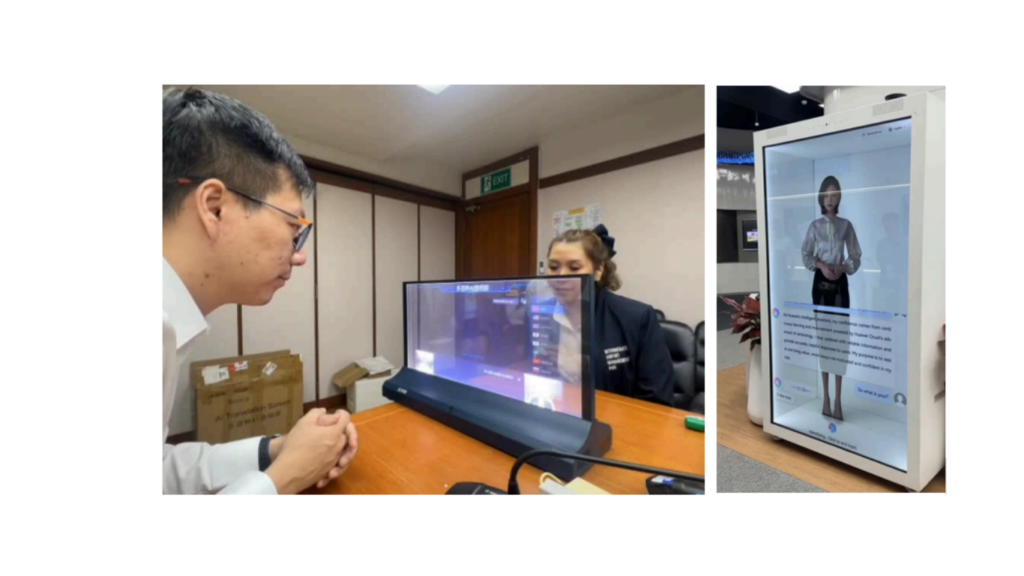
Don Mueang International Airport (DMK) has launched 3 months pilot project to provide real-time translation and automated information services for international passengers, covering both manned service counters and high-traffic public areas.
Background and Objectives: Currently, DMK primarily provides translation support in Chinese and English. However, with an increasingly diverse passenger base and a limited number of translation service points, communication barriers have emerged, impacting passenger confidence. This project aims to bridge these language gaps, elevate the Customer Experience, and support Airport Service Quality (ASQ) goals while reinforcing AOT’s international image.
Key Technologies:
-
Multilingual AI Transparent Screens: Installed at service counters and key points across the airport, these screens facilitate two-way, real-time translated conversations on a transparent display. Equipped with specialized microphones and cameras that focus on the speaker, the system effectively minimizes background noise.
-
AI Virtual Assistants: Deployed in public areas to provide proactive assistance. Both systems support voice commands and are linked to a Cloud-based Knowledge Base to ensure that all provided information remains accurate and up-to-date.
Evaluation and Future Roadmap: Throughout the trial period, satisfaction data will be collected from both staff and passengers, focusing on convenience, accuracy, and response speed. AOT will evaluate the project’s overall efficiency and cost-effectiveness to determine the feasibility of a full-scale rollout. This includes a comprehensive review of data governance and privacy protocols to ensure full compliance with relevant international standards.